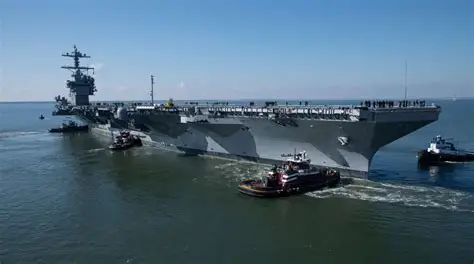
The sun has barely crested the horizon, but already the air is alive with the thunderous roar of jet engines. At the Huntington Ingalls Industries’ Newport News shipyard, a new era of American naval dominance is about to unfold. The USS John F. Kennedy, the U.S. Navy’s latest nuclear-powered aircraft carrier, is finalizing its preparations for a crucial set of sea trials that will push this formidable warship to its limits.
This isn’t just any ordinary vessel, though. The Kennedy represents a bold leap forward in both technology and strategy. As the second ship in the Ford-class of supercarriers, it’s a testament to the Navy’s commitment to maintaining its global superiority. But the story behind this ship’s creation is not what you might expect.
A Carrier Built for the Modern Era
The USS John F. Kennedy is no mere upgrade to the previous Nimitz-class carriers. It’s a complete reimagining of what a 21st-century aircraft carrier should be. From its advanced electromagnetic aircraft launch system to its cutting-edge combat systems, every aspect of this ship has been designed to meet the evolving challenges of modern warfare.
Gone are the traditional steam-powered catapults that have launched countless aircraft over the decades. In their place, the Kennedy boasts an electromagnetic aircraft launch system (EMALS) that promises greater flexibility, reliability, and efficiency. This technological leap forward not only enhances the carrier’s combat capabilities but also reduces the strain on both the airframes and the crew.
- ➡The Shocking Secret to Unlock Your Hip Mobility (You Won’t Believe How Easy It Is!)
- ➡One Simple Change That Turned This Teacher Into a Sustainable Fashion Hero
- ➡What Italian Chefs Don’t Want You to Know About Perfect Pasta Sauce
- ➡The Unlikely Household Item That’s Actually a Secret Cleaning Powerhouse
But the innovations don’t stop there. The Kennedy’s nuclear propulsion system is engineered to provide power for up to half a century, reducing the need for refueling and ensuring the ship’s endurance. Combined with its advanced sensors, communications, and defensive systems, this carrier is poised to be a formidable asset in any maritime conflict.
The Sea Trials Ahead: Testing Every System
As the Kennedy prepares to set sail for its inaugural sea trials, the stakes couldn’t be higher. This is the moment when the ship’s countless systems and technologies will be put to the test, pushing the boundaries of what a modern aircraft carrier can achieve.
From the smooth operation of the EMALS to the seamless integration of the combat systems, every aspect of the Kennedy’s performance will be scrutinized by the Navy’s most experienced crews. Failure is not an option, as any glitches or malfunctions could delay the ship’s eventual deployment and jeopardize its readiness.
But the Navy is confident in the Kennedy’s capabilities. The years of meticulous planning, design, and construction have all led to this moment, and the crew is eager to prove the ship’s worth on the open seas.
- ➡The Baffling River That Flows Uphill for Over 100 Miles – The Shocking Explanation Behind It
- ➡Revealed: Turkey’s Jaw-Dropping Jet That’s Shaking Up the Aerospace Industry
- ➡Could China’s Tree Planting Efforts Actually Be Hurting the Environment?
- ➡The Shocking Thing I Saw After Falling 40 Feet That Made Me Wish I’d Never Survived
Nuclear Propulsion: Power for Fifty Years
The USS John F. Kennedy’s nuclear propulsion system is a true marvel of engineering, setting it apart from previous aircraft carriers. Unlike the oil-fired boilers of the past, this ship’s reactors can provide enough power to sustain it for up to half a century, eliminating the need for frequent refueling.
This extended endurance not only enhances the Kennedy’s strategic mobility but also reduces the logistical burden on the Navy. By eliminating the need to regularly replenish fuel supplies, the ship can remain at sea for longer periods, projecting American power and influence across vast stretches of the globe.
Moreover, the nuclear propulsion system’s sheer power output allows the Kennedy to support a wider range of advanced systems and technologies, from high-energy weapons to energy-intensive sensors and communications equipment. This versatility is a crucial advantage in the ever-evolving landscape of modern warfare.
Electromagnetic Aircraft Launch System: Evolution of a Technology
The USS John F. Kennedy’s electromagnetic aircraft launch system (EMALS) represents a significant leap forward in carrier aviation technology. Unlike the traditional steam-powered catapults, EMALS uses a series of powerful electromagnets to gently accelerate aircraft into the air, reducing the strain on both the airframes and the launch crews.
- ➡Australians Risk Losing $2,400 Before April – Pension Alert You Must See!
- ➡Shocking Truth: The Brain’s Nighttime Struggle to Process Emotions Keeps You Awake (Nobody Told You This)
- ➡11 Astronomical Wonders That Redefine Our Understanding of the Universe
- ➡Renowned Chefs Reveal Their Mornay Sauce Secrets for Unbeatable Vegetable Gratins
This innovative approach not only improves the carrier’s launch capacity but also enhances its operational flexibility. The EMALS can handle a wider range of aircraft, from nimble fighter jets to heavier cargo planes, allowing the Kennedy to adapt to a wider range of mission profiles.
Moreover, the EMALS is designed to be more reliable and efficient than its predecessors, reducing maintenance requirements and ensuring a smoother, more consistent launch process. As the Navy navigates the increasingly complex challenges of modern warfare, this technology could prove to be a game-changer in the skies above the open ocean.
Combat Systems Integration: Tying It All Together
The USS John F. Kennedy’s true strength lies not in any single component, but in the seamless integration of its various systems and technologies. From the advanced radar and sensor suites to the cutting-edge communications networks, every aspect of the ship’s combat capabilities has been carefully designed to work in concert.
This integration allows the Kennedy to rapidly process and respond to a wide range of threats, from enemy aircraft and missiles to surface vessels and even submarines. The ship’s advanced decision support systems can analyze massive amounts of data in real-time, enabling the crew to make informed, split-second choices that could mean the difference between victory and defeat.
But the true genius of the Kennedy’s combat systems lies in their adaptability. As new threats and technologies emerge, the ship’s software-defined architecture can be easily updated, ensuring that it remains a formidable force in the ever-changing landscape of modern warfare.
The Broader Strategic Significance
The USS John F. Kennedy’s significance extends far beyond its impressive technological capabilities. As the second ship in the Ford-class of supercarriers, it represents a critical component of the U.S. Navy’s long-term strategy for maintaining global dominance.
These carriers are designed to project American power and influence across vast stretches of the world’s oceans, providing a mobile and versatile platform for a wide range of military and humanitarian operations. From air strikes and amphibious assaults to disaster relief and medical aid, the Kennedy is poised to be a vital asset in the Navy’s arsenal.
Moreover, the development of the Ford-class carriers is a clear signal to the world that the United States is committed to maintaining its naval superiority. In an era of growing geopolitical tensions and technological advancements, the Kennedy’s mere presence can serve as a deterrent to potential adversaries, ensuring the continued stability and security of the global maritime order.
- ➡Is China’s WeChat Surveillance Actually More Dystopian Than We Think?
- ➡The Shocking Truth About the Mysterious Yellow Ribbon on Dog Leashes That Everyone Needs to Know
- ➡$931 Government Payment Delay Rule 2026: Australians Urged to Track Claim Status Immediately…
- ➡The Shocking Truth About Saudi Arabia’s Futuristic Transport Dream
Timeline and Next Steps
The USS John F. Kennedy’s journey to this point has been a long and arduous one, marked by years of meticulous planning, design, and construction. With the sea trials now underway, the ship is poised to enter the final phase of its commissioning process, paving the way for its eventual deployment.
Following the successful completion of the sea trials, the Kennedy will undergo a series of additional tests and certifications to ensure its combat readiness. This process is expected to take several months, during which time the ship’s crew will undergo extensive training and familiarization with the vessel’s systems and capabilities.
Once this final phase is complete, the USS John F. Kennedy will be officially commissioned and integrated into the U.S. Navy’s fleet, joining the ranks of the world’s most advanced and powerful aircraft carriers. This milestone will mark a new era in American naval power, one that is poised to shape the course of global affairs for decades to come.
Challenges and Risk Factors
Despite the USS John F. Kennedy’s impressive array of technologies and capabilities, the path to its completion has not been without its share of challenges and risk factors. From cost overruns to technical glitches, the development of this carrier has been a complex and demanding endeavor.
- ➡You Won’t Believe What This Homeless Man Did for a Stranger – The Ripple Effect Will Shock You
- ➡The Shocking Truth About the Mysterious Visitor Hurtling Towards Our Solar System at Record Speeds
- ➡Australia Fuel Price Drop 2026: Government Cuts Tax for 3 Months…
- ➡Passport Rule Changes for Over 60s in Australia (2026 Update)…
One of the primary concerns has been the performance of the EMALS system, which has faced a series of development issues and setbacks. The Navy has had to work closely with the system’s manufacturers to ensure its reliability and compatibility with the carrier’s diverse array of aircraft. Any failures or malfunctions during the sea trials could delay the ship’s commissioning and jeopardize its operational readiness.
Additionally, the sheer complexity of the Kennedy’s combat systems integration has presented its own set of challenges. Ensuring seamless communication and coordination between the ship’s various sensors, weapons, and decision-support systems has required meticulous planning and extensive testing. Any breakdowns or glitches in this critical area could have devastating consequences in a real-world conflict.
Conclusion: A Ship Ready to Prove Itself
As the USS John F. Kennedy prepares to embark on its inaugural sea trials, the anticipation is palpable. This ship represents the culmination of years of innovation, engineering, and strategic planning, and its success will have far-reaching implications for the future of American naval power.
The Kennedy’s cutting-edge technologies, from its electromagnetic aircraft launch system to its advanced combat integration, have the potential to redefine the very nature of naval warfare. But beyond the technical specifications, this carrier also stands as a symbol of the United States’ unwavering commitment to maintaining its global influence and protecting its interests on the high seas.
- ➡This Woman Saved A Stranger From Drowning – And Then Realized She Knew Him From 12 Years Ago
- ➡The Real Reason Your Family Inheritance May Never Be the Same Again
- ➡The Shocking Truth Behind China’s Billion-Tree Reforestation Miracle
- ➡Unbelievable! I Found My Dead Mother’s Handwriting in a $2 Used Cookbook – You Won’t Believe What Happened Next
In the days and weeks ahead, the world will be watching as the USS John F. Kennedy puts its mettle to the test. And when the dust settles, this formidable warship will have the opportunity to prove that it is not just a marvel of modern engineering, but a true force to be reckoned with on the global stage.
Frequently Asked Questions
What makes the USS John F. Kennedy different from previous aircraft carriers?
The USS John F. Kennedy is the second ship in the Ford-class of supercarriers, which feature a range of advanced technologies and capabilities that set them apart from previous Nimitz-class carriers. These include the electromagnetic aircraft launch system (EMALS), improved power generation and distribution, and more efficient and integrated combat systems.
How long can the USS John F. Kennedy remain at sea without refueling?
The Kennedy’s nuclear propulsion system is designed to provide power for up to 50 years, significantly reducing the need for refueling and enhancing the ship’s operational endurance and strategic mobility.
What are the key capabilities of the USS John F. Kennedy’s combat systems?
The Kennedy’s combat systems are designed to be highly integrated, allowing for rapid data processing and decision-making. This includes advanced radar and sensor suites, sophisticated communications networks, and software-defined systems that can be easily updated to address emerging threats.
- ➡The Shocking Truth Behind Why He Left Her at the Altar – You Won’t Believe What Happened Next
- ➡The Dangerous Truth About the Longest Solar Eclipse of the Century You Need to Know Now
- ➡Australia Passport Cancelled 2026: Key Travel Rules Every Senior Must Know…
- ➡Stop Considering These Partners for Turkey’s Next-Gen Kaan Fighter
How does the USS John F. Kennedy’s electromagnetic aircraft launch system (EMALS) work?
The EMALS uses a series of powerful electromagnets to gently accelerate aircraft into the air, in contrast to the traditional steam-powered catapults used on older carriers. This system is designed to be more reliable, efficient, and capable of launching a wider range of aircraft.
What are the key challenges the USS John F. Kennedy has faced during its development?
The development of the USS John F. Kennedy has faced a number of challenges, including cost overruns, technical issues with the EMALS system, and the complexity of integrating the ship’s various combat systems. The Navy has had to work closely with manufacturers and contractors to address these challenges and ensure the carrier’s readiness for deployment.
How will the USS John F. Kennedy contribute to the U.S. Navy’s global strategy?
As the second ship in the Ford-class of supercarriers, the USS John F. Kennedy represents a crucial component of the U.S. Navy’s long-term strategy for maintaining global dominance. The carrier’s advanced capabilities and endurance will allow it to project American power and influence across vast stretches of the world’s oceans, supporting a wide range of military and humanitarian operations.
When will the USS John F. Kennedy be commissioned and deployed?
Following the successful completion of its sea trials, the USS John F. Kennedy will undergo additional testing and certifications to ensure its combat readiness. This process is expected to take several months, after which the ship will be officially commissioned and integrated into the U.S. Navy’s fleet, paving the way for its eventual deployment.
What are the potential impacts of the USS John F. Kennedy’s capabilities on global maritime security?
The USS John F. Kennedy’s advanced technologies and combat systems have the potential to reshape the balance of power in the global maritime domain. Its mere presence can serve as a deterrent to potential adversaries, while its versatility and endurance allow it to support a wide range of military and humanitarian operations that contribute to the overall stability and security of the world’s oceans.