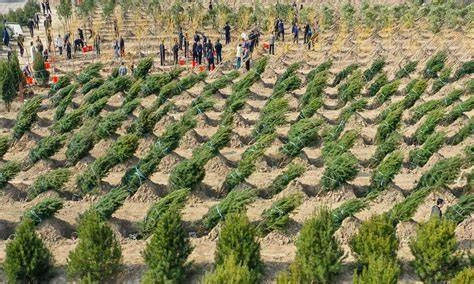
As you gaze out across the Kubuqi Desert in China’s Inner Mongolia region, the scene is strikingly different from just a few decades ago. Where endless sand dunes once stretched to the horizon, lush greenery now covers the landscape. This transformation is the result of an ambitious tree-planting initiative launched by the Chinese government in the 1990s, which has since seen over 1 billion trees take root. But is this large-scale reforestation effort truly the environmental win it’s often touted as?
On the surface, China’s tree-planting program appears to be a resounding success. By transforming vast swaths of degraded land into thriving forests, the initiative has slowed the expansion of the country’s deserts and helped restore damaged ecosystems. However, a closer examination reveals that this green transformation may come with some unexpected consequences that challenge the conventional narrative of environmental restoration.
Unintended Consequences of China’s Tree Planting Efforts
While the sheer number of trees planted is undoubtedly impressive, experts warn that the program’s reliance on non-native species and monoculture plantations could be doing more harm than good in the long run. “By focusing on fast-growing, water-intensive trees like eucalyptus, China has created artificial forests that are often ecologically unsustainable,” explains Dr. Liang Xiaodong, a forest ecologist at Peking University.
These monoculture plantations, though visually appealing, lack the biodiversity of natural forests and can actually contribute to water scarcity in already arid regions. “The thirsty trees suck up precious groundwater, leaving less for local communities and wildlife,” Liang adds. “In some cases, this has exacerbated desertification rather than reversing it.”
- ➡Shocking Discovery: Man Finds His Own Obituary Online – You Won’t Believe What Happened Next!
- ➡The Heartwarming Story Behind the Birthday Card My Mom Sent Me Every Year for 20 Years
- ➡She Risked Everything to Expose China’s Controversial AI Crime Prediction System — The Shocking Consequences
- ➡The Shocking Truth Chefs Don’t Want You to Know About Roasted Garlic Pasta
Moreover, the push to meet ambitious tree-planting targets has led to the displacement of indigenous communities and the destruction of existing grasslands and shrublands – ecosystems that are just as vital to the region’s delicate balance.
Rethinking China’s Approach to Reforestation
As the limitations of China’s current reforestation model become increasingly apparent, experts are calling for a more nuanced and sustainable approach. “We need to move away from a one-size-fits-all mentality and instead focus on restoring native species and ecosystems that are adapted to the local climate and soil conditions,” says Dr. Mei Xueqin, a policy researcher at the Chinese Academy of Social Sciences.
This shift would not only improve the long-term viability of the forests but also better support the livelihoods and cultural practices of indigenous communities. “Engaging local stakeholders and incorporating traditional ecological knowledge is crucial for creating restoration projects that are truly beneficial and lasting,” Mei adds.
Furthermore, researchers suggest that China should prioritize the protection and restoration of existing natural forests, which often harbor greater biodiversity and ecosystem services than newly planted trees. “It’s not just about the quantity of trees, but the quality and composition of the forests,” explains Dr. Li Jia, a conservation biologist at the Chinese Academy of Forestry.
Balancing Ecological and Economic Priorities
China’s tree-planting initiative has undoubtedly yielded some positive results, such as generating new economic opportunities and providing carbon sequestration benefits. However, as the country continues to refine its approach, it must carefully weigh these gains against the potential environmental and social costs.
“We need to recognize that not all tree-planting projects are created equal,” says Mei Xueqin. “The goal should be to foster diverse, resilient ecosystems that can withstand the challenges of climate change, not just create a green veneer.”
By striking this delicate balance, China has the opportunity to transform its vast, degraded landscapes into true ecological powerhouses – but only if it is willing to learn from the past and embrace a more holistic, community-based model of environmental restoration.
The Future of China’s Green Belt
As China continues to expand its tree-planting efforts under the ambitious “Great Green Wall” initiative, the stakes have never been higher. With a goal of planting an additional 66 million hectares of forest by 2050, the country’s environmental future hangs in the balance.
- ➡Centrelink Payment Dates Changing in April 2026 – Seniors Must Check…
- ➡Doctors Gave Me 6 Months to Live, But I Defied the Odds 11 Years Later — Then I Got This Unexpected Letter
- ➡Why Everyone Is Suddenly Talking About the Asteroid That Rewrote Earth’s History
- ➡The Forgotten Island That’s Actually a Troubling Toxic Dump
Yet, with the right approach – one that prioritizes biodiversity, water conservation, and the needs of local communities – China’s tree-planting program could become a true global model for sustainable land restoration. “The potential is there, but it will require a fundamental rethinking of how we approach these projects,” says Li Jia. “If we get it right, the benefits could be transformative, not just for China, but for the entire planet.”
Lessons for the Rest of the World
As the effects of climate change continue to reshape landscapes around the world, China’s experience with large-scale reforestation offers valuable insights for other nations grappling with land degradation and desertification.
“The key is to avoid a one-size-fits-all mentality and instead focus on restoring ecosystems that are tailored to local conditions,” explains Dr. Liang Xiaodong. “This requires a deep understanding of the region’s ecology, as well as close collaboration with indigenous communities and other stakeholders.”
Moreover, Liang emphasizes the importance of ongoing monitoring and evaluation to ensure the long-term viability of reforestation efforts. “It’s not enough to just plant the trees and walk away,” he says. “We need to continuously assess the health of the forests and make adjustments as needed to ensure they are truly thriving.”
A New Era of Sustainable Restoration
As the world grapples with the mounting challenges of climate change, environmental degradation, and biodiversity loss, China’s tree-planting initiative serves as a powerful reminder that bold action is necessary – but it must be accompanied by a deep commitment to ecological and social sustainability.
By learning from the past and embracing a more holistic, community-based approach to restoration, China has the opportunity to transform its vast, arid landscapes into vibrant, resilient ecosystems that benefit both people and the planet. The future of the “Great Green Wall” may not be as straightforward as it first appears, but the potential rewards are too great to ignore.
| Key Milestones in China’s Tree Planting Efforts | Impact on Land Restoration |
|---|---|
| 1978: The “Three-North Shelter Forest Program” launched to combat desertification | Over 66 million hectares of new forests established, but with limited long-term success |
| 1994: The “Grain for Green” program initiated to convert degraded farmland into forests and grasslands | Improved vegetation cover in some regions, but often with non-native species that disrupted local ecosystems |
| 2000s: The “Great Green Wall” initiative announced, with a goal of planting 66 million hectares of new forests by 2050 | Over 1 billion trees planted since the 1990s, but concerns over water scarcity and biodiversity impacts |
“The focus on quantity over quality has led to the creation of artificial forests that are often ecologically unsustainable. We need to shift towards restoring native species and ecosystems that are adapted to the local environment.”
Also Read
- ➡A Small Habit That Transformed Her Relationship Forever
- ➡The Shocking Phrases That Deeply Selfish People Use (You Won’t Believe #4!)
- ➡Top Experts Reveal the Shocking Secret My Grandmother Told Me on Her Deathbed – Now I Understand Why Dad Never Came Home
- ➡“I Was That Child”: Mom’s Shocking Discovery After Daughter’s Unexpected Photo Comment
Dr. Liang Xiaodong, Forest Ecologist, Peking University
“Engaging local stakeholders and incorporating traditional ecological knowledge is crucial for creating restoration projects that are truly beneficial and lasting. It’s not just about planting trees, but about fostering diverse, resilient ecosystems.”
Dr. Mei Xueqin, Policy Researcher, Chinese Academy of Social Sciences
“The potential of China’s tree-planting efforts is enormous, but it will require a fundamental rethinking of how we approach these projects. If we get it right, the benefits could be transformative, not just for China, but for the entire planet.”
Also Read
- ➡Microwaves vs. The New Kitchen Revolution — Which One Reigns Supreme?
- ➡Centrelink Youth Allowance 2026: A Weekly Raise of $430?
- ➡Shocking New Driving Age Revealed: What Every Driver Needs to Know Before It’s Too Late
- ➡Unlock Your Full Potential: 7 Yoga Poses That Will Transform Your Flexibility and Mobility
Dr. Li Jia, Conservation Biologist, Chinese Academy of Forestry
As the old saying goes, “the road to hell is paved with good intentions.” China’s ambitious tree-planting program is a powerful reminder that even the most well-intentioned environmental initiatives can have unintended consequences if not carefully designed and implemented. By learning from the past and embracing a more holistic, community-based approach to restoration, China has the opportunity to transform its vast, degraded landscapes into true ecological powerhouses – but the path forward is anything but simple.
What are the main criticisms of China’s tree-planting program?
The main criticisms of China’s tree-planting program are that it has relied too heavily on non-native, water-intensive tree species that have disrupted local ecosystems and exacerbated water scarcity in some regions. There are also concerns that the program has displaced indigenous communities and destroyed existing grasslands and shrublands, which are equally vital to the region’s ecological balance.
What are the potential long-term consequences of China’s tree-planting efforts?
If China continues with its current approach, the potential long-term consequences include further desertification, biodiversity loss, and water scarcity. Experts warn that the monoculture plantations of fast-growing, thirsty trees could ultimately undermine the very environmental restoration they were intended to achieve.
How can China improve the sustainability of its reforestation efforts?
Experts recommend that China shift towards a more holistic, community-based approach to reforestation that prioritizes the restoration of native species and ecosystems adapted to local conditions. This would involve greater collaboration with indigenous communities, incorporation of traditional ecological knowledge, and ongoing monitoring and adjustment to ensure the long-term viability of the forests.
What lessons can other countries learn from China’s tree-planting experience?
The key lessons for other countries include the importance of avoiding a one-size-fits-all mentality, prioritizing biodiversity and ecosystem restoration over pure tree-planting targets, and engaging local stakeholders to ensure the long-term sustainability of reforestation efforts. Ongoing monitoring and evaluation are also crucial to identify and address any unintended consequences.
How does China’s tree-planting program fit into its broader environmental and climate change goals?
China’s tree-planting efforts are a central part of its broader strategy to combat desertification, restore degraded landscapes, and contribute to global climate change mitigation. However, experts argue that the program needs to be better integrated with other environmental policies and initiatives to ensure a more holistic and sustainable approach.
What are the economic and social implications of China’s reforestation efforts?
While China’s tree-planting program has generated new economic opportunities, such as ecotourism and forest-based industries, there are also concerns about the displacement of indigenous communities and the disruption of traditional livelihoods. Striking the right balance between ecological and economic priorities will be crucial for the long-term success of these efforts.
- ➡The Incredible 2-Year Secret Love Story You Never Knew About Until His Funeral
- ➡[Researchers] Say This Common Household Ingredient Is the Key to Driving Rats Out of Your Home for Good
- ➡The Unexpected Discovery That Shattered My Best Friend’s Trust
- ➡The Delightfully Moist Cake That’s Actually Good for You
How is China collaborating with other countries on global reforestation initiatives?
China is actively involved in international efforts to combat desertification and restore degraded landscapes, such as the United Nations’ “Great Green Wall” initiative. However, experts argue that China’s own experiences and lessons learned should inform a more collaborative, knowledge-sharing approach with other countries facing similar challenges.
What are the future targets and goals for China’s tree-planting program?
China has set an ambitious goal of planting an additional 66 million hectares of new forests by 2050 as part of its “Great Green Wall” initiative. However, the success of this effort will depend on the country’s ability to shift towards a more sustainable, community-based model of reforestation that prioritizes biodiversity and long-term ecosystem health.