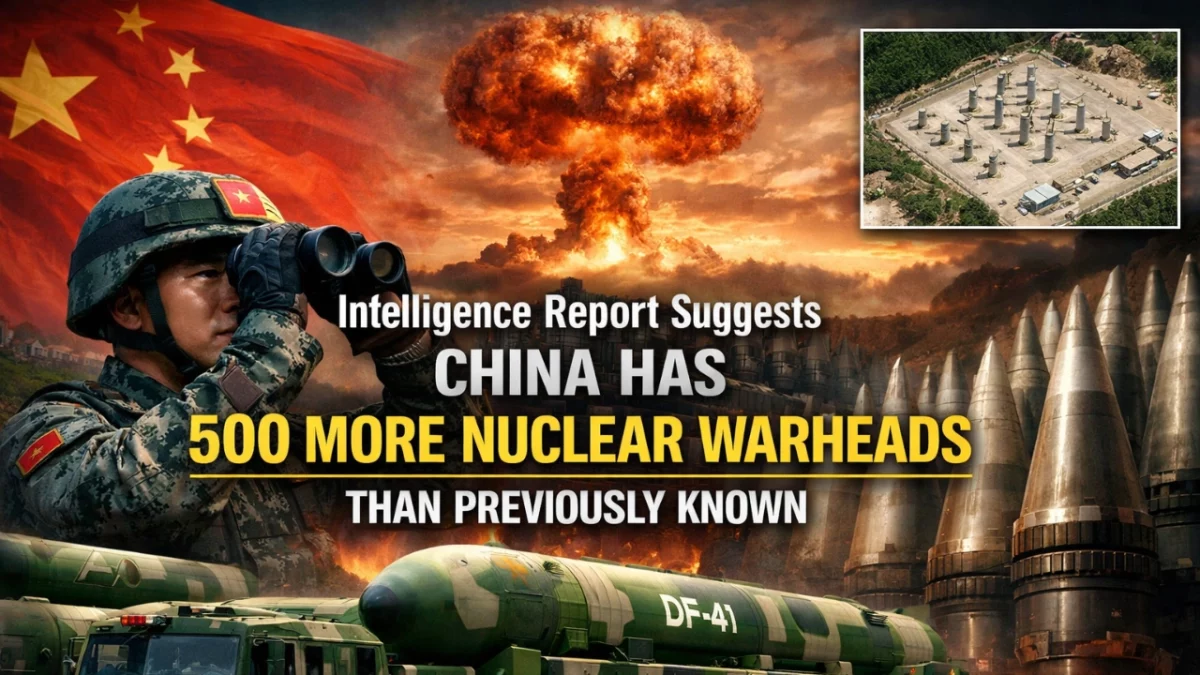
In the hushed silence of the Pentagon’s secure briefing room, a single piece of paper held the power to reshape the global nuclear landscape. As defense officials pored over the classified intelligence report, their eyes widened in disbelief – China’s nuclear arsenal was far more extensive than previously believed, with a staggering 500 more warheads than previously known.
This startling revelation, long concealed from the public eye, threatened to upend decades of nuclear strategy and international diplomacy. The implications were staggering, and the race was on to understand the full scope of China’s covert weapons expansion program.
In a world where the delicate balance of power hinges on the fragile equilibrium of nuclear forces, this discovery threatened to tilt the scales, with far-reaching consequences for global security and the future of international relations.
Uncovering the Tip of the Iceberg: China’s Covert Nuclear Buildup
For years, the global community had operated under the assumption that China’s nuclear stockpile was relatively modest, a fraction of the massive arsenals maintained by the United States and Russia. But this intelligence report shattered that perception, revealing a startling truth – China had been quietly and steadily expanding its nuclear capabilities, amassing a formidable force that had long evaded detection.
The report’s findings painted a picture of a meticulously planned and executed weapons program, one that leveraged advanced technology, strategic deception, and a relentless pursuit of military superiority. Analysts pored over satellite imagery, intercepted communications, and a tapestry of intelligence data, piecing together a disturbing pattern of hidden missile silos, covert research facilities, and clandestine production lines.
This revelation challenged long-held assumptions about the balance of power in the Asia-Pacific region and beyond, forcing policymakers to reconsider the strategic landscape and reevaluate their approach to global security.
Missed Opportunities and the Failure of Intelligence
As the implications of the report sank in, a wave of frustration swept through the defense and intelligence community. How had this massive buildup gone undetected for so long? Experts and analysts scrutinized past assessments, searching for the blind spots and missed signals that had allowed China’s nuclear ambitions to grow unchecked.
The answers were sobering – a complex web of technological limitations, geopolitical tensions, and institutional biases had all contributed to this intelligence failure. Satellites and surveillance systems had struggled to penetrate the shroud of secrecy surrounding China’s nuclear program, while political sensitivities had discouraged a more aggressive pursuit of the truth.
In the aftermath of this discovery, a reckoning was underway. Policymakers demanded answers, and intelligence agencies scrambled to shore up their capabilities, determined to prevent such a blindspot from ever occurring again.
Shaking the Foundations of Global Nuclear Order
The reverberations of this intelligence coup extended far beyond the Pentagon’s walls. Diplomatic channels hummed with activity as allies and adversaries alike grappled with the implications of China’s nuclear expansion. Longstanding assumptions about the balance of power were called into question, and the delicate web of nuclear deterrence that had underpinned global stability for decades threatened to unravel.
Concerns mounted over the potential for an arms race, as nations scrambled to reassess their own nuclear postures and deterrence strategies. The prospect of a multipolar nuclear world, with China as a formidable new player, raised the specter of heightened tensions, increased risk of miscalculation, and the possibility of a destabilizing arms race.
Policymakers wrestled with the strategic dilemma – how to respond to this new reality without escalating tensions or igniting a dangerous spiral of retaliation and counter-retaliation. The road ahead was fraught with uncertainty, as the global community grappled with the seismic shift in the nuclear landscape.
- ➡The Shocking Truth: How a $11 Dropout Rebuilt His Life and Reconnected with His Father After Years of Silence
- ➡The Heartbreaking Reason I’ve Waited 7 Years for a Man Who Never Showed Up — Until a Stranger Changed Everything
- ➡Could China’s Tree Planting Efforts Actually Be Hurting the Environment?
- ➡The Dangerous Toilet Hack You’re Probably Using Right Now (And Why You Need to Stop)
Rethinking Nuclear Nonproliferation and Disarmament
The revelation of China’s expanded nuclear arsenal also cast a long shadow over the global nonproliferation and disarmament efforts that had defined the post-Cold War era. Decades of hard-fought progress toward nuclear restraint and arms reduction now faced a sobering setback, as the world struggled to come to terms with this new nuclear reality.
Experts and policymakers alike debated the implications for existing treaties and agreements, questioning whether the established frameworks could still effectively curb the spread of nuclear weapons and promote global stability. Concerns grew over the potential for a domino effect, as other nations might feel compelled to bolster their own nuclear capabilities in response to China’s buildup.
In the halls of power, intense discussions took place on the need to revitalize and adapt the international nuclear order, striking a delicate balance between deterrence, verification, and the pursuit of meaningful disarmament. The stakes had never been higher, as the world confronted the prospect of a new era of heightened nuclear competition.
Forging a New Path Forward in a Multipolar Nuclear World
As the dust settled and the initial shock waves subsided, the global community faced a daunting task – charting a path forward in a world where the nuclear landscape had been fundamentally reshaped. Policymakers, military strategists, and diplomats convened to devise new strategies and frameworks that could navigate this uncharted territory.
Calls for strengthened intelligence-gathering capabilities, enhanced transparency, and more robust verification mechanisms echoed through the corridors of power. Simultaneously, discussions around the need for innovative arms control measures and creative diplomatic solutions took center stage, as the world grappled with the challenge of maintaining stability in the face of a shifting nuclear balance.
The road ahead was fraught with challenges, but the imperative was clear – to establish a new paradigm of global security that could withstand the realities of a multipolar nuclear world, where the delicate balance of power had been irrevocably altered by China’s covert weapons expansion.
The Human Cost of Nuclear Brinksmanship
As the world’s attention fixated on the geopolitical and strategic implications of China’s nuclear buildup, it was easy to lose sight of the human toll that such developments could exact. The specter of nuclear war, once a distant and abstract concern, now loomed closer, with the potential to devastate populations and communities across the globe.
Experts and humanitarian organizations raised the alarm, warning of the catastrophic humanitarian consequences that could result from any escalation of nuclear tensions. The images of Hiroshima and Nagasaki, long seared into the collective consciousness, served as a haunting reminder of the unimaginable suffering that nuclear weapons could inflict.
In this charged environment, the imperative to prioritize the well-being of people over the calculus of power became increasingly urgent. Policymakers were called upon to ensure that any response to China’s nuclear expansion would be grounded in the protection of human life and the promotion of global peace.
Navigating an Uncertain Future in the Nuclear Age
As the global community grappled with the implications of China’s expanded nuclear arsenal, a profound sense of unease and uncertainty hung in the air. The delicate balance that had defined the post-Cold War era had been irreversibly disrupted, and the path forward was shrouded in complexity and risk.
Yet, amidst the challenges, there was a glimmer of hope – a recognition that the world had faced similar crossroads before and had, through a combination of diplomacy, innovation, and collective resolve, managed to avert the worst-case scenarios. The task now was to harness that resilience and ingenuity to navigate this new nuclear landscape, to forge a future where the specter of global annihilation gave way to a more stable and secure world.
The road ahead would be arduous, marked by difficult choices, tense negotiations, and the need to confront deeply entrenched geopolitical rivalries. But the stakes were too high to falter. The future of humanity itself hung in the balance, and the world’s leaders were called upon to rise to the occasion, to chart a course that would safeguard the precious gift of peace for generations to come.
- ➡You Won’t Believe the Gigantic Harpy Eagle Chick Discovered in Brazil’s Untamed Pantanal Rainforest!
- ➡The Shocking Reason This Mom Cried in the Shower — and How It Changed a Therapist’s Approach Forever
- ➡You’ll Never Believe What This Man’s Last Words Were Before He Died
- ➡Major Companies Just Mandated Return to Office and It Changes Everything for Remote Workers
Experts Weigh In: Navigating the New Nuclear Landscape
“This discovery has shaken the very foundations of our global security architecture. We are now facing a reality where the delicate balance of nuclear deterrence that has kept the world at peace for decades is under threat. The implications are far-reaching and will require a complete rethinking of our approach to arms control and nonproliferation.”
– Dr. Sarah Lohmann, Senior Fellow at the Center for Strategic and International Studies
“China’s covert nuclear buildup represents a seismic shift in the global power dynamics. This discovery will force the United States and its allies to reassess their defense postures and deterrence strategies, potentially leading to an escalation of tensions and an arms race that could destabilize the entire international order.”
– General (Ret.) David Petraeus, Former Commander of U.S. Forces in Afghanistan
Also Read
- ➡The Heartbreaking Airport Mystery: 14 Hours of Waiting, But Her Loved One Never Arrived
- ➡China’s Surprise Rise to AI Chip Supremacy Rattles Silicon Valley
- ➡The Surprising Superpower of the Quiet Ones: How the Most Respected People Captivate Without Saying Much
- ➡What China’s Secret Desert Structure Could Mean for the World
“The world is now facing the prospect of a multipolar nuclear landscape, where the risk of miscalculation and unintended escalation is higher than ever before. Policymakers must act swiftly and decisively to establish new frameworks for arms control and crisis management, lest we sleepwalk into a catastrophic conflict.”
– Dr. Lora Saalman, Senior Fellow at the Carnegie-Tsinghua Center for Global Policy
What is the significance of this intelligence discovery?
The discovery that China’s nuclear arsenal is significantly larger than previously believed has far-reaching implications for global security. It challenges long-held assumptions about the balance of power and the stability of the international nuclear order. Policymakers now face the daunting task of rethinking deterrence strategies, arms control measures, and crisis management frameworks in a multipolar nuclear landscape.
How could this impact US-China relations and regional stability?
The revelation of China’s covert nuclear buildup is likely to heighten tensions between the United States and China, as well as with other regional powers. There are concerns that this could trigger an arms race as nations seek to bolster their own nuclear capabilities in response. This could destabilize the delicate balance of power in the Asia-Pacific region and beyond, increasing the risk of miscalculation and unintended escalation.
- ➡A Small Tweak That Ballooned the Cost of a New Fighter Jet
- ➡Japan Just Discovered This One-Cut Citrus Trick and It’s Changing Everything
- ➡Japan Just Revealed the Surprising Trick That’s Transforming Hardwood Floors Nationwide
- ➡China Just Seized Control of Africa’s Lithium Reserves and It Changes Everything
What are the key challenges in verifying and monitoring China’s nuclear program?
The intelligence failure that allowed China’s nuclear expansion to go undetected for so long highlights the significant challenges in verifying and monitoring covert weapons programs. Technological limitations, geopolitical sensitivities, and institutional biases have all contributed to these blindspots. Addressing these issues will require a concerted effort to enhance intelligence-gathering capabilities, improve transparency, and establish more robust verification mechanisms.
How might this discovery impact global nuclear nonproliferation efforts?
The revelation of China’s expanded nuclear arsenal could have a detrimental impact on global nuclear nonproliferation and disarmament efforts. It may undermine confidence in existing treaties and agreements, and spur other nations to reevaluate their own nuclear postures. Policymakers will need to devise innovative strategies and frameworks to revitalize the international nuclear order and maintain stability in this new multipolar environment.
What are the potential humanitarian consequences of this nuclear buildup?
The prospect of heightened nuclear tensions and the increased risk of conflict raises grave humanitarian concerns. Experts warn of the catastrophic impact that even a limited nuclear exchange could have on civilian populations and communities. Policymakers must ensure that any response to China’s nuclear expansion prioritizes the protection of human life and the promotion of global peace, rather than simply the strategic calculus of power.
How might this intelligence discovery affect global alliances and security cooperation?
The revelation of China’s expanded nuclear arsenal is likely to have a significant impact on global alliances and security cooperation. Nations may feel compelled to reevaluate their own defense postures and seek closer ties with like-minded partners, potentially leading to the formation of new security arrangements and the realignment of geopolitical allegiances. Navigating these shifting dynamics will be a crucial challenge for policymakers in the years ahead.
- ➡Shock Closure of Gulf Airspace: The Real Story Behind the Chaos at Dubai and Riyadh Airports!
- ➡Why Everyone Is Suddenly Sleeping With Their Pets (And Loving It)
- ➡The Shocking Truth My Son Uncovered About His Father’s Secret Life
- ➡Lavender Bloom Breaks Records Across Southern France as Soil Bacteria Ignite Early Flowering
What are the next steps for the global community in addressing this issue?
The global community faces a daunting task in charting a path forward in the wake of this intelligence discovery. Strengthening intelligence capabilities, enhancing transparency, and devising innovative arms control measures will be essential. Diplomacy and multilateral cooperation will be crucial in establishing a new framework for nuclear stability and global security. Ultimately, the world must come together to confront this challenge and ensure that the specter of nuclear catastrophe does not cast a shadow over the future of humanity.
How might this discovery impact China’s global standing and influence?
The revelation of China’s covert nuclear buildup is likely to have a significant impact on its global standing and influence. It may erode trust and undermine China’s efforts to portray itself as a responsible global power committed to peace and stability. The international community may be more skeptical of China’s intentions and seek to counter its growing influence, potentially leading to increased geopolitical tensions and a shift in the global balance of power.